Aerial Roof Thermography Services
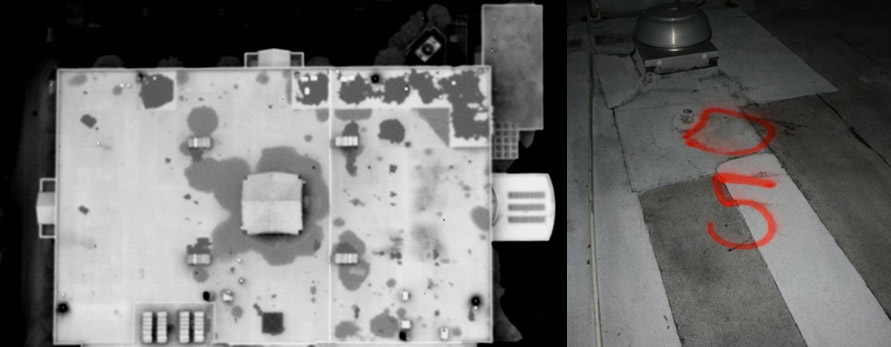
RoofScanIR provides professional aerial roof thermography services to help building owners, facility managers, roof consultants, and roofing contractors evaluate potential moisture problems across large roofing systems. Using infrared thermal imaging from aerial platforms, qualified thermographers can survey suitable roof surfaces and identify temperature patterns that may indicate trapped moisture beneath the roof membrane. Aerial infrared surveys can be particularly useful for extensive commercial, industrial, and institutional properties where efficient coverage and consistent documentation are important for roof maintenance planning.
Moisture can enter roofing systems through damaged membranes, failed flashing, deteriorated seams, and poorly sealed penetrations. Once trapped in insulation or other roof components, water may contribute to material deterioration and eventually cause interior leaks. Aerial infrared roof inspections help identify areas that warrant further investigation, giving property owners and roofing professionals useful information for evaluating roof conditions and planning appropriate repairs.
How Aerial Infrared Roof Surveys Work
Roofing materials absorb solar energy during the day and release stored heat as conditions change. Under suitable environmental conditions, areas containing moisture may retain heat differently from surrounding dry areas. An infrared camera captures these surface temperature variations, allowing a trained thermographer to identify patterns that may be associated with concealed moisture.
During an aerial infrared roof survey, thermal imaging is collected from an aerial platform selected for the project and site conditions. The resulting images are evaluated to identify thermal anomalies and areas that may require closer examination. Aerial surveys can help cover extensive roof areas efficiently, but the results depend on roof materials, weather, image quality, and the thermal contrast available during the inspection.
Infrared imaging does not directly see water beneath the roofing membrane. Thermal anomalies can have causes other than moisture, so suspected wet areas may need to be verified through secondary moisture detection methods or physical testing. Not every roof is suitable for aerial infrared inspection.
Aerial Infrared Inspections for Large Commercial Roofs
Large warehouses, distribution centers, manufacturing facilities, retail buildings, office complexes, and institutional properties can have extensive roof areas that are difficult to assess efficiently through visual inspection alone. Aerial thermography can provide broad coverage of suitable roofs and help identify locations that deserve additional investigation.
Our commercial roof infrared inspection services help property owners and facility managers investigate potential moisture problems and make informed decisions about maintenance and repairs. For manufacturing plants, warehouses, and other industrial properties, see our industrial roof infrared inspection page for more information.
Detect Potential Roof Moisture from Above
Aerial infrared surveys can help identify thermal patterns consistent with moisture in suitable flat and low-slope roofing systems. These patterns provide a starting point for locating areas that may contain wet insulation or other concealed moisture. By identifying areas of concern, property teams can prioritize follow-up testing rather than investigating the entire roof indiscriminately.
Learn more about the inspection process on our infrared roof moisture surveys page. You can also explore how thermal imaging helps identify potential moisture-related temperature patterns in our article on thermal imaging for roof moisture.
Benefits of Aerial Roof Thermography
For suitable roofing systems, aerial thermography can offer several practical advantages:
- Efficient roof coverage: Survey large roof areas without relying exclusively on walking inspections.
- Identification of potential problem areas: Locate thermal anomalies that may indicate trapped moisture and require further evaluation.
- Support for targeted repairs: Help roofing professionals focus secondary testing on specific locations.
- Maintenance planning: Provide information that supports repair prioritization and long-term roof asset management.
- Documented findings: Use thermal images and supporting photographs to help communicate inspection results.
Aerial thermography is a diagnostic tool rather than a substitute for a complete roof assessment. Findings should be considered alongside roof construction, visible conditions, secondary testing, and the recommendations of a qualified roofing professional.
Aerial Surveys for Flat and Low-Slope Roofs
Many commercial and industrial properties use flat or low-slope roofing systems that may be suitable for infrared moisture surveys under the right conditions. RoofScanIR evaluates project requirements and roofing characteristics to help determine the most appropriate inspection method.
For additional information about roof-specific inspection methods, visit our pages on flat roof infrared inspection and low-slope roof infrared inspection. These pages explain how infrared thermography can help investigate potential moisture in suitable roofing assemblies.
Reporting and Roof Maintenance Planning
Aerial infrared survey findings are most useful when they are clearly documented and connected to identifiable roof locations. RoofScanIR provides inspection reporting that may include thermal images, supporting roof photographs, and documentation of thermal anomalies and areas of suspected moisture. This information helps building owners, roof consultants, facility managers, and contractors determine where additional testing may be needed.
Clear reporting can support roof maintenance budgets, repair planning, and long-term roof asset management. To see examples of survey documentation, visit our sample roof inspection projects page.
Schedule an Aerial Infrared Roof Survey
RoofScanIR serves clients through a network of certified thermographers, with on-roof and aerial infrared survey options available for suitable projects. Whether you manage a large industrial facility, a commercial building, or multiple properties, we can help you evaluate your inspection needs and determine whether aerial thermography is appropriate for your roofing system.
Contact RoofScanIR to discuss your roof size, roofing materials, inspection goals, and site requirements. Our team can help you understand the available survey options and how infrared findings may support informed roof maintenance and repair decisions.
Who We Are
RoofScanIR™ is a National Network of Certified Thermographers having been trained in the application of infrared thermography of flat roofs. All the network members are experienced building technicians and Certified Infrared Thermographers. The thermographers all own their own companies and are members in good-standing in the RoofScanIR™ Network. Call our office today or request a survey via our website to locate a certified technician in your area.
Contact Us
Corporate Office
8472 Adams Farm Road
Randleman, NC 27317
Telephone: 888-722-6447
FAX: 888-722-6447
E-mail: info@unitedinfrared.com
Accounting Office
P.O. Box 1403
Bonsall, CA 92003
Telephone: 888-722-6447
FAX: 888-722-6447
E-mail: accounting@unitedinfrared.com